

What face redaction protects, what it does not protect, and how engineering teams should validate it in production.
Face redaction is an automated process that detects faces in images or video and obscures their identifying features. When redaction occurs at the edge, before footage is stored, transmitted, or shared, it can reduce unnecessary identity exposure while preserving the operational value of the scene.
Face redaction can serve as a practical privacy-by-design control. It does not automatically make video anonymous or make a system compliant with a particular law. The result depends on the complete data flow, redaction method, detection performance, retention rules, access controls, and whether other information can still identify a person.
Key Takeaways
- Face redaction reduces direct facial-identification risk while preserving activity and scene context.
- Edge processing can keep unredacted footage out of cloud and downstream workflows.
- Clothing, gait, tattoos, location, timestamps, license plates, voice, metadata, and other information can still create re-identification risk.
- Face redaction should be evaluated as a complete video pipeline and supported by appropriate governance, security, and legal review.
What Is Privacy-by-Design Face Redaction?
Privacy-by-design face redaction makes identity protection part of the video architecture rather than a manual step after collection.
The system detects each visible face, maintains redaction coverage as the face moves across frames, applies a visual transformation, and sends the redacted output to approved downstream systems.
This approach applies data minimization directly to the video pipeline. If an application needs traffic flow, safety context, queue length, or publishable footage, but does not need facial identity, the system can limit exposure of facial detail beyond the point required to redact it.
Whether an original stream is also returned or made available depends on the customer’s deployment architecture and controls.
The European Union’s General Data Protection Regulation (GDPR) Article 25 requires controllers to implement appropriate technical and organizational measures that effectively implement data-protection principles, including data minimization. European Data Protection Board guidance states that measures must be effective, documented, reviewed, and appropriate to the specific processing risk.
Face redaction can be one such measure. Its suitability must be established within the actual use case.
How Does Real-Time Face Redaction Work?
A production face-redaction pipeline performs a sequence of connected functions. Privacy performance depends on the entire sequence rather than a single detector score.
| Stage | Function | Description |
|---|---|---|
| 1 | Ingest | Decode a camera stream, recorded video, or still image. |
| 2 | Detect | Locate visible faces across changes in scale, pose, motion, and lighting. |
| 3 | Track | Maintain a stable redaction region around each face across consecutive frames. |
| 4 | Redact | Apply blur or another masking transformation to the defined region. |
| 5 | Validate | Identify missed faces, late masks, coverage loss, and incomplete redaction. |
| 6 | Output | Encode and route the redacted stream under access and retention policies. |
A fast mask is not protective if the detector misses a small, partially occluded, or side-profile face. A strong detector is not sufficient if tracking drops the mask for several frames. End-to-end behavior determines the real privacy outcome.
Why Process Face Redaction at the Edge?
Edge face redaction processes video near the camera or on a local server. Its primary privacy advantage is architectural. Unredacted frames do not have to travel to a remote service or enter general-purpose storage before protection is applied.
This approach can reduce data movement, limit the systems handling identifiable imagery, and constrain the consequences of a downstream breach or misconfiguration. It can also lower live-video latency and support environments with limited connectivity.

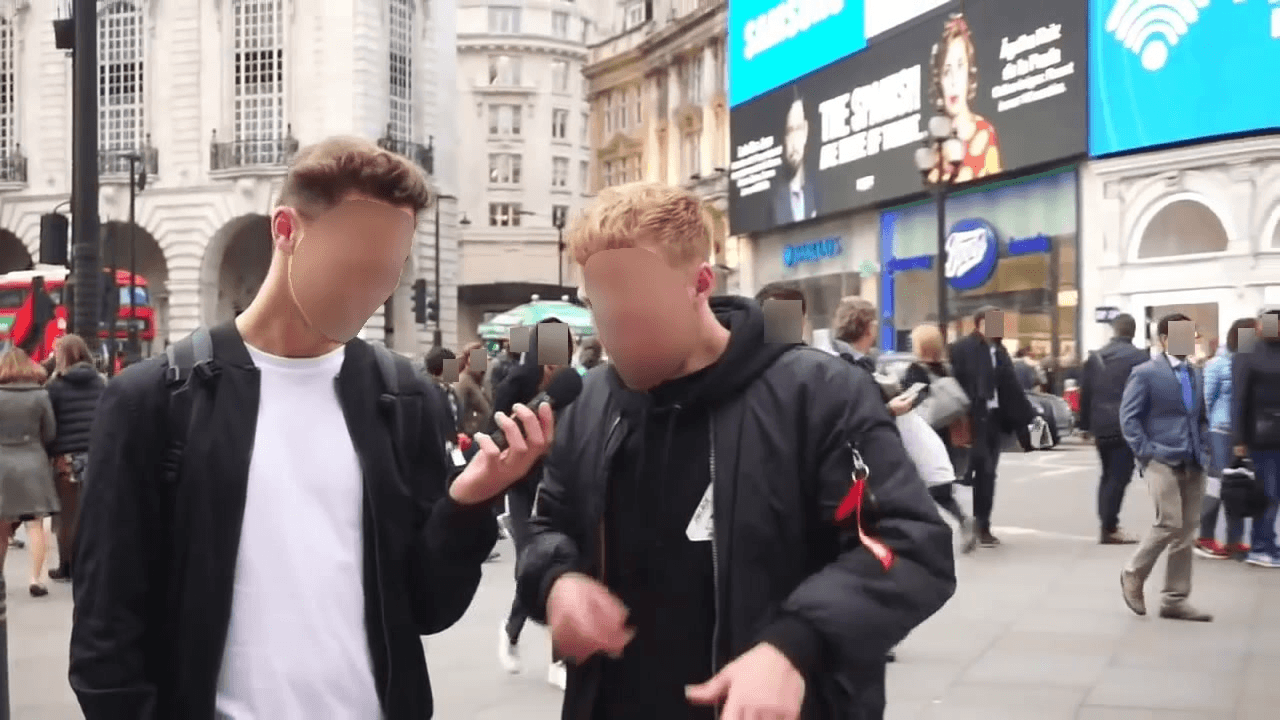
Real-time face redaction in a public transit setting. Image source: AlgoFace demonstration footage.
AlgoFace Face Redaction is designed for real-time processing at the edge. It obscures facial features while preserving body movement and environmental context for smart infrastructure, security and public safety, journalism, and media workflows.
Edge deployment is not automatically private. Temporary buffers, diagnostic logs, fail-open behavior, administrator access, and the original camera feed all remain part of the threat model.
What Does Face Redaction Protect?
Face redaction primarily reduces exposure of visible facial identity. It can support analysis or controlled sharing without giving every downstream viewer access to an unobscured face. The adjacent controls remain essential.
| Control Objective | How Redaction Helps | Organizational Governance |
|---|---|---|
| Minimize identity exposure | Removes or degrades visible facial detail | Lawful purpose and collection rules |
| Restrict downstream access | Sends redacted rather than raw video | Roles, permissions, audit logs, and export controls |
| Preserve scene utility | Retains actions, movement, and environment | Proportionality of remaining surveillance |
| Reduce cloud exposure | Redacts locally before transmission | Device security, buffers, updates, and incident response |
| Support controlled disclosure | Produces a privacy-enhanced derivative for sharing | Review of audio, metadata, license plates, and other potential identifiers |
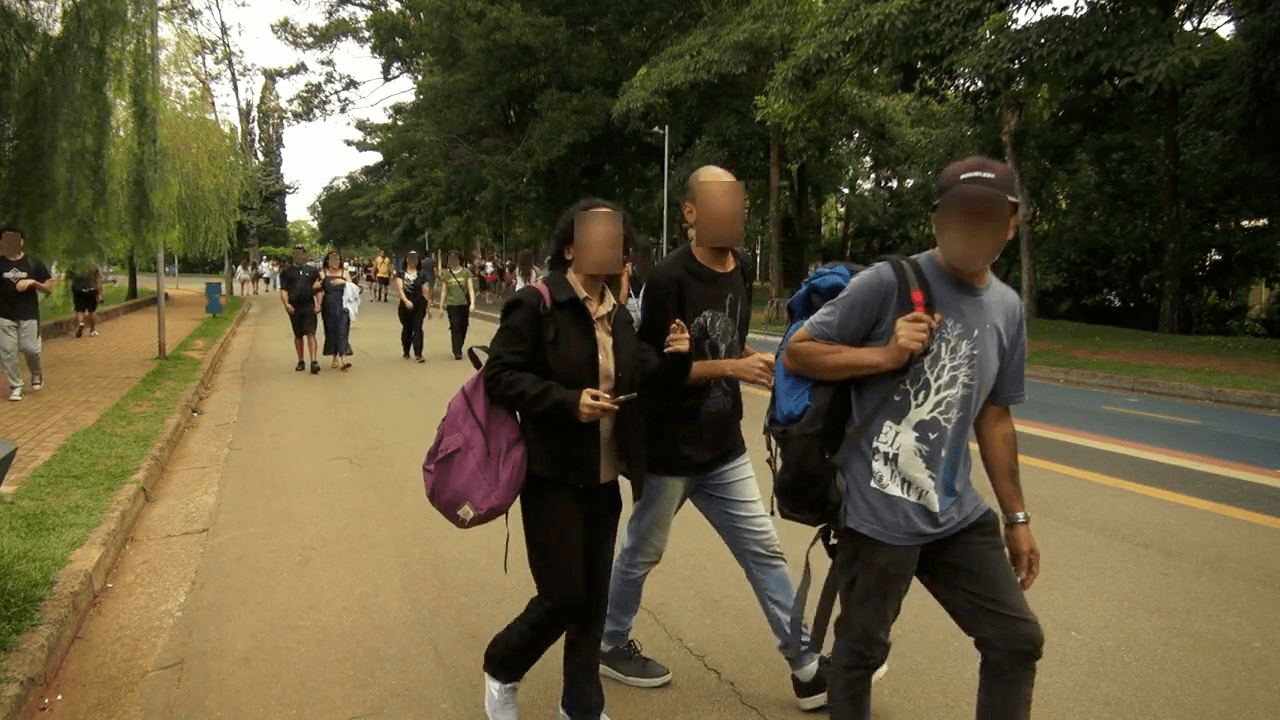
Face redaction can limit facial exposure while preserving activity and scene context. Image source: AlgoFace demonstration footage.
What Does Face Redaction Not Protect?
Face redaction does not erase the person from the scene. A person may remain recognizable from distinctive clothing, tattoos, body shape, gait, companions, vehicle, location, time, or spoken voice. Reflections and screens may reveal an unmasked face. Metadata may connect the footage to another record. Weakly configured blur may preserve enough structure for human or machine inference.
The terms redacted, de-identified, pseudonymized, and anonymous are not interchangeable. GDPR Recital 26 requires identifiability to be assessed using the means reasonably likely to be used by the controller or another person. NIST also notes that de-identification can reduce privacy risk without necessarily eliminating the possibility of re-identification in NISTIR 8053.
Key Takeaway: The technically defensible claim is that face redaction reduces a defined identity risk under stated conditions. A claim of anonymization requires a broader assessment of the remaining identifiers and realistic re-identification paths.
How Should Organizations Validate a Face-Redaction System?
Validation should reflect the deployment environment rather than a generic test set. The following measures should inform acceptance criteria, production signals, and periodic privacy and security reviews.
| Validation Metric | Operational Focus |
|---|---|
| Missed-face rate | The percentage of visible faces receiving no mask. |
| Leakage frames | Frames exposed before detection or during track loss. |
| Coverage quality | Whether the mask fully covers identifying facial regions. |
| Scenario performance | Results for small faces, crowds, motion blur, low light, occlusion, and non-frontal pose. |
| Latency and throughput | Sustained performance at the target resolution, frame rate, and face count. |
| False-positive impact | Unnecessary masking that reduces evidentiary or operational value. |
| Re-identification resistance | Whether tested people or models can still link subjects using the redacted output and surrounding data. |
| Failure behavior | Whether the system fails closed, alerts an operator, or passes raw frames when capacity is exceeded. |
The NIST Privacy Framework provides a broader voluntary structure for identifying and managing privacy risk across the system lifecycle.
Frequently Asked Questions About Face Redaction
Is face redaction the same as anonymization?
No. Face redaction obscures a direct visual identifier. Footage is anonymous only when a person is no longer identifiable using means reasonably likely to be used, considering the remaining video, audio, metadata, and available external information.
Does blurring faces make video GDPR compliant?
Not on its own. Face blur may support data minimization and privacy by design, but compliance also depends on purpose, legal basis, transparency, access, retention, security, data-subject rights, and the effectiveness of the redaction in context.
Is edge face redaction better than cloud redaction?
For workloads that do not require raw video in the cloud, edge redaction can reduce transmission of identifiable frames and lower latency. The correct architecture still depends on hardware capacity, operational controls, reliability, and the organization’s threat model.
What is the most important face-redaction metric?
There is no single sufficient metric. Privacy evaluation should combine missed-face rate, leakage frames, coverage, challenging-condition performance, sustained throughput, and re-identification testing.
What is real-time face redaction used for?
Real-time face redaction can support video workflows that require scene context without requiring facial identity as a default output. Applications include smart infrastructure, security and public safety, transportation, journalism, media, video management systems, and other enterprise video workflows.
Building Face Redaction Into the Video Architecture
A responsible video architecture limits identifiable data at the earliest practical point, preserves only what the stated purpose requires, and continuously verifies that the protection works.
Real-time edge face redaction makes that principle operational. Clear governance, measured performance, secure deployment, and accurate claims allow organizations to retain visual context without making facial identity the default output.
AlgoFace provides face AI enterprise infrastructure designed for flexible deployment across enterprise video environments. AlgoFace Face Redaction enables real-time facial redaction at the edge while preserving the visual context organizations need for downstream applications and workflows.
Contact AlgoFace to discuss deployment architecture, operational requirements, and video privacy needs.
References
About the Author
Taleb Alashkar, PhD is Co-founder and Chief Technology Officer of AlgoFace. His work focuses on computer vision, machine learning, and face AI enterprise infrastructure designed for real-world and edge environments.