
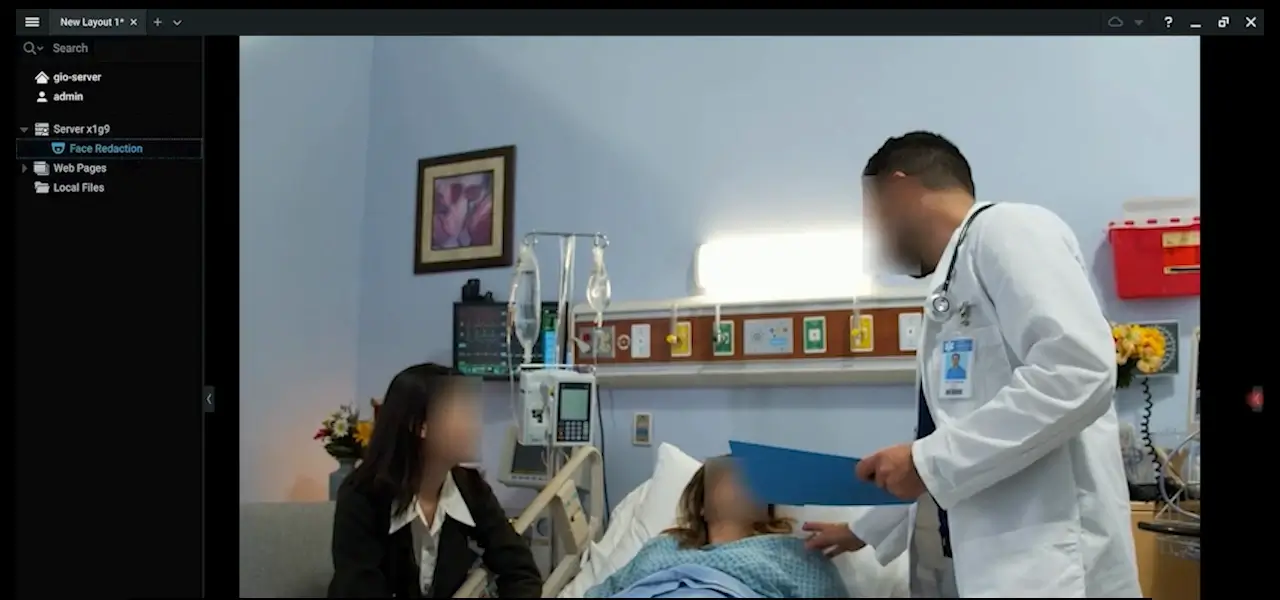
Every day, video systems capture countless faces across cities, businesses, and public spaces. While this footage serves important safety, security, and operational purposes, not every use case requires access to the faces of the people captured. Unnecessary facial exposure can introduce privacy and security risks and undermine public trust.
AlgoFace addresses this challenge with real-time, edge-based face redaction, preserving the operational value of video while reducing unnecessary facial exposure. By integrating our Face Redaction SDK into existing video management systems (VMS), we bring this capability directly into the infrastructure organizations already use.
From SDK to VMS: A Reusable Integration Architecture
AlgoFace’s Face Redaction SDK handles face detection, tracking, and redaction. For developers, the SDK provides the building blocks to incorporate these capabilities into applications. Organizations operating camera networks, however, need processed video that works within their existing VMS.
Our architecture separates the core redaction engine from the platform-specific integration layer. The SDK performs the computer vision processing, while the integration layer connects to video sources, receives frames, manages streams, and delivers processed video in a format the VMS can consume. This separation allows us to adapt to different platforms without rebuilding the underlying face-redaction engine.
Our integrations with video management platforms from Network Optix and Hanwha Vision demonstrate this architecture in practice. Both bring AlgoFace’s Face Redaction technology into established video management environments, with support for Ubuntu and Windows. These integrations illustrate our broader approach to bringing face redaction into enterprise video infrastructure rather than limiting the platforms we can support.
Engineering Face Redaction for Continuous Video
Blurring a face in a single image is only a small part of the problem. Live video arrives continuously while operators open views, cameras disconnect, and multiple streams compete for processing resources. A production VMS integration must coordinate computer vision with the timing and lifecycle of a live media system.
1. Maintaining Redaction Across Video Frames
Video is a sequence, not a collection of independent images. A person may turn away, move rapidly, or pass behind another object. Processing every frame independently can create inconsistent masking as these conditions change.
AlgoFace’s SDK combines face detection and tracking to help maintain redaction across successive frames. Performance must still be evaluated against expected conditions, including motion, lighting, camera perspective, and scene complexity.
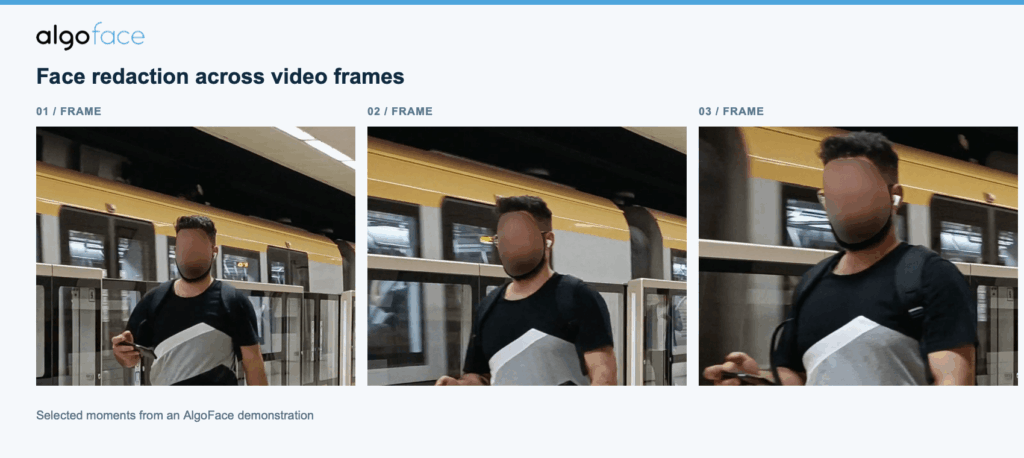
Face redaction across three moments in a subway station demonstration.
2. Turning Processed Frames into a VMS Video Source
A VMS expects a usable video stream, not a collection of processed images.
In a typical supported VMS integration, a compatible RTSP feed supplies video to the processing pipeline. The input is decoded into frames, processed through the AlgoFace Face Redaction SDK, and encoded for delivery to the VMS.
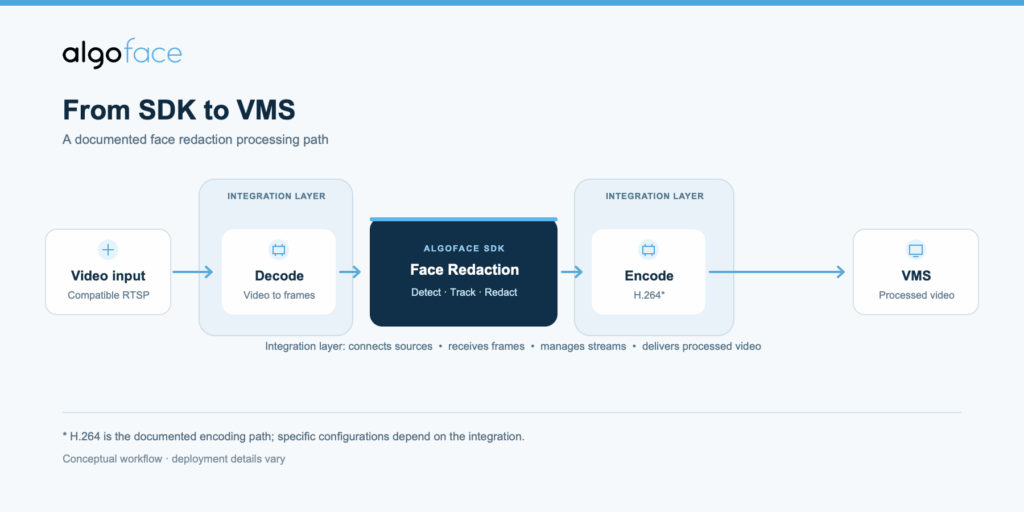
AlgoFace’s video processing architecture integrates face detection, tracking, and redaction into VMS workflows.
The documented processing architecture uses H.264 encoding to deliver compressed video to the VMS rather than raw image frames. During normal redaction operation, masking is incorporated into the output frames, allowing the processed result to appear as a distinct video source through the platform’s established device workflow. In the Network Optix integration, operators can add the redacted output as a distinct video source in Nx Witness or Nx Go through the platform’s existing device workflow.
3. Managing Stream Lifecycle and Recovery
Cameras disconnect, network conditions change, and operators request different video streams throughout the day. A production VMS integration must manage these interruptions while efficiently allocating and releasing processing resources.
AlgoFace’s integration layer starts capture in response to stream requests and releases idle processing resources when they are no longer needed. It also manages recovery at the individual stream level, helping a disconnected camera recover without requiring other streams to restart.
Deployment validation should include startup, reconnection, and recovery conditions to confirm that redaction behaves as expected throughout the stream lifecycle. These capabilities operate alongside the face-redaction engine and are essential to maintaining reliable video processing in enterprise environments.
4. Controlling Buffering and Latency
When video arrives faster than it can be processed, frames may accumulate in a queue. Without appropriate controls, an apparently smooth display can become a delayed view of events, reducing its usefulness for time-sensitive operations.
AlgoFace’s integration manages buffering to prevent processing backlogs from growing unchecked. By coordinating video ingestion, processing, and delivery, the system helps control latency while maintaining the operational value of the video stream.
5. Sizing Processing Resources
Real-time face redaction requires evaluating the entire video pipeline, from decoding and face detection through tracking, redaction, and encoding. Resolution, frame rate, scene complexity, and the number of concurrent streams all affect how much video the system can process in real time.
AlgoFace Face Redaction supports both CPU-based processing and GPU acceleration. To determine which configuration fits your deployment, test it with representative streams under expected operating conditions and measure throughput and latency at the planned stream count.
Edge-Based Processing and Privacy
Where video is processed is an important architectural consideration. Workflows that require footage to be exported, transferred, or uploaded for additional processing can introduce additional opportunities for unnecessary access or exposure.
AlgoFace supports real-time, edge-based face redaction, allowing video to be processed locally within supported deployment environments rather than requiring cloud-based processing. This approach helps organizations incorporate privacy-conscious video processing into existing infrastructure while reducing unnecessary movement of video data.
Processed video sources can support different operational audiences without routinely exposing facial details they do not need. Organizations should also validate that recording, playback, and export workflows use the intended processed video source, while separately managing access to any retained originals through appropriate access controls and retention policies. While face redaction reduces visible facial detail, other information such as clothing, location, and contextual records may still make individuals identifiable.
Expanding face redaction in Peachtree Corners
Curiosity Lab at Peachtree Corners, Georgia, tests connected infrastructure and mobility technologies in a working city environment. Network Optix’s Nx Go platform is already integrated into the city’s IoT Control Room, where it brings traffic and sensor information into a common operational view.
AlgoFace is expanding its face redaction deployment in Peachtree Corners to cover more cameras at additional locations. In a traffic operations setting, a redacted feed can preserve the movement of vehicles and pedestrians while reducing the facial detail visible to people who use the footage.
From Integration to Real-World Infrastructure
The need for face redaction extends across smart cities, transportation systems, healthcare facilities, commercial properties, and public spaces. While these environments have different operational requirements, they share a common challenge: preserving useful video information while reducing unnecessary facial exposure.
For example, traffic management teams may need to monitor vehicle and pedestrian movement without accessing facial details, while facilities operators may need to investigate an obstruction or safety concern without exposing everyone captured in the footage.
By integrating face redaction into existing video management infrastructure, AlgoFace enables organizations to evaluate these capabilities within established workflows rather than introducing separate processing applications. The same core technology can support different VMS environments, with compatibility, performance, and deployment requirements evaluated for each integration.
Making Face Redaction Part of Enterprise Video Infrastructure
Moving face redaction from an SDK into a VMS requires more than connecting an algorithm to a camera feed. It involves coordinating computer vision, video decoding and encoding, stream lifecycle management, buffering, recovery, and processing resources to deliver reliable video within established operational systems.
By separating its core Face Redaction SDK from platform-specific integrations, AlgoFace can extend these capabilities across different video management environments without rebuilding the underlying technology.
The result is a scalable approach to bringing real-time, edge-based face redaction into enterprise video infrastructure, helping organizations preserve operational visibility while reducing unnecessary facial exposure.
Learn more about AlgoFace Face Redaction or contact our team to discuss VMS integration and deployment requirements.